
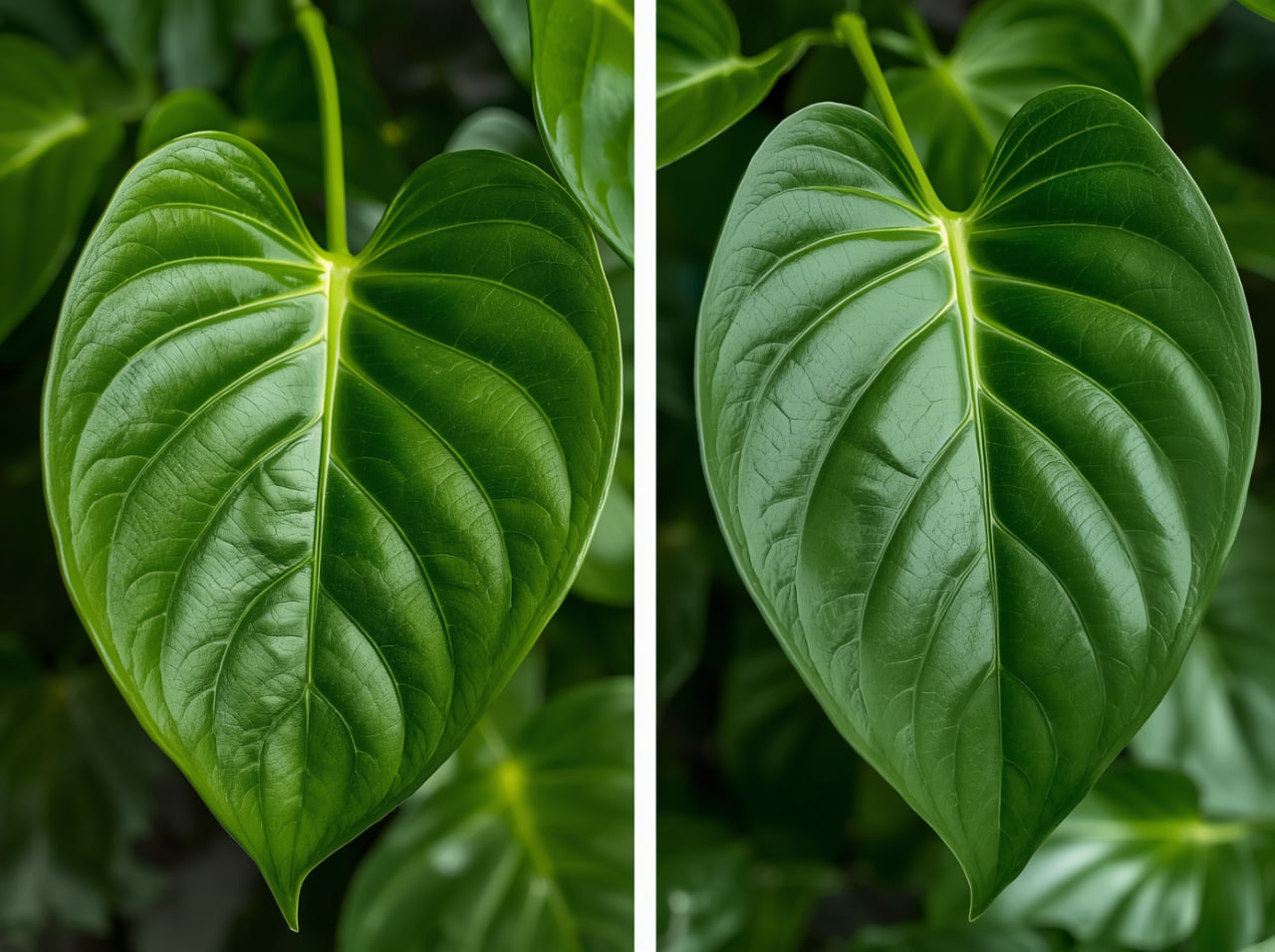
Pothos and heartleaf philodendron are two of the most popular and widely sold houseplants in the world, and they are also the two plants most frequently confused with each other. Sold side by side in nurseries, often described with overlapping care requirements, and looking superficially similar, they cause genuine confusion even among experienced plant growers.
Understanding the differences between them matters not just for accurate identification but because their care requirements, while similar in many ways, do differ in meaningful details. This guide gives you the definitive identification criteria and comprehensive care guidance for both plants.
How to Tell Them Apart: The Definitive Guide
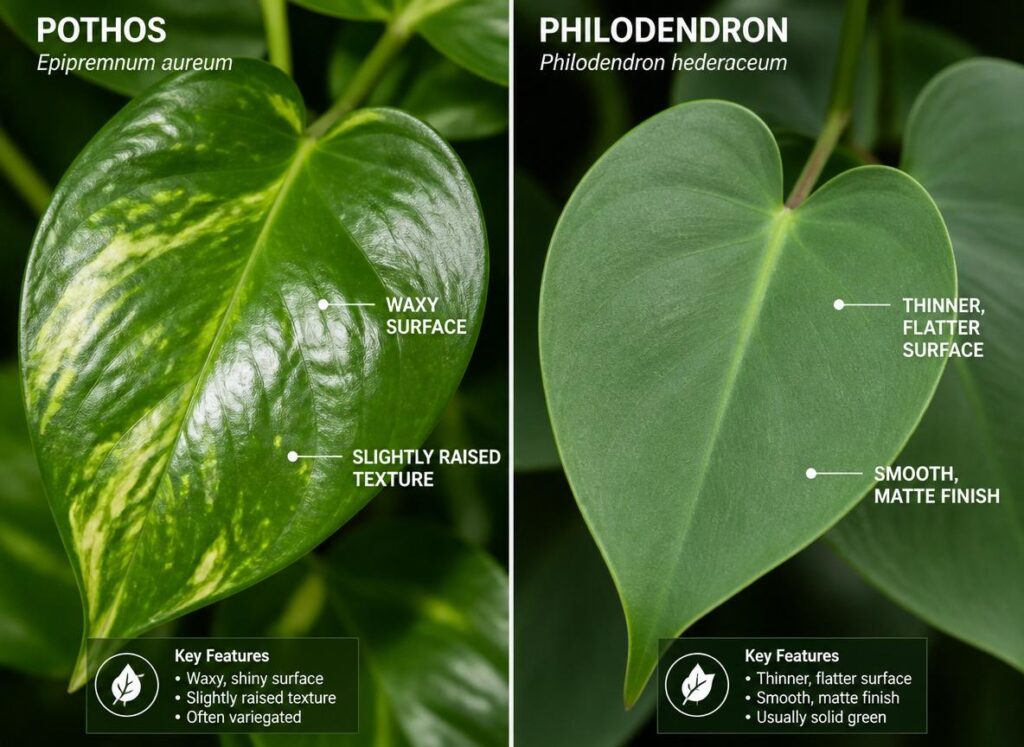
1. Leaf Texture and Surface
This is the most reliable single identification characteristic. Pothos (Epipremnum aureum) leaves have a thick, waxy, slightly bumpy or textured surface that feels firm and somewhat rigid. Heartleaf philodendron (Philodendron hederaceum) leaves are thinner, more flexible, and have a completely flat, smooth, matte surface. Run your finger across the leaf: waxy and textured is pothos; smooth and flat is philodendron.
2. The Cataphyll (Unique to Philodendron)
This is the single most definitive identification feature. Philodendrons produce a cataphyll: a small, papery, leaf-like sheath that wraps around each new leaf as it develops. Once the new leaf unfurls, the cataphyll remains on the stem and slowly dries and browns. Pothos produces no cataphyll whatsoever. If you see a dry, papery sheath at the base of new leaves, it is definitely a philodendron.
3. Petiole (Leaf Stem) Shape
Look at the petiole, the stem that connects the leaf to the main vine. In pothos, the petiole is indented or channeled along its upper surface, forming a groove. In heartleaf philodendron, the petiole is rounded and uniform in cross-section, without any groove or indentation.
4. Leaf Shape
Pothos leaves tend to be less symmetrically heart-shaped, with one side of the base slightly larger than the other (asymmetrical at the base). Heartleaf philodendron leaves are more perfectly heart-shaped with a deeper, more symmetric basal notch where the leaf meets the petiole.
5. New Leaf Color
Heartleaf philodendron produces new leaves in a distinctive bronze-red color that gradually transitions to green as the leaf matures. This bronze new-leaf coloration is a reliable field mark for philodendron. Pothos new leaves emerge as a pale, slightly yellow-green rather than bronze.
6. Leaf Size
In similar conditions, pothos generally produces larger leaves than heartleaf philodendron. Mature pothos leaves can reach six to eight inches; heartleaf philodendron leaves are typically four to six inches on indoor plants.
Quick Identification Cheat Sheet
- Waxy, slightly bumpy leaf surface → Pothos
- Smooth, flat, thin leaf surface → Philodendron
- Papery sheath (cataphyll) on new growth → Philodendron (100 percent certain)
- Grooved (channeled) petiole → Pothos
- Round petiole → Philodendron
- New leaves emerge bronze-red → Philodendron
- New leaves emerge pale yellow-green → Pothos
Pothos Care: The Complete Guide
Light
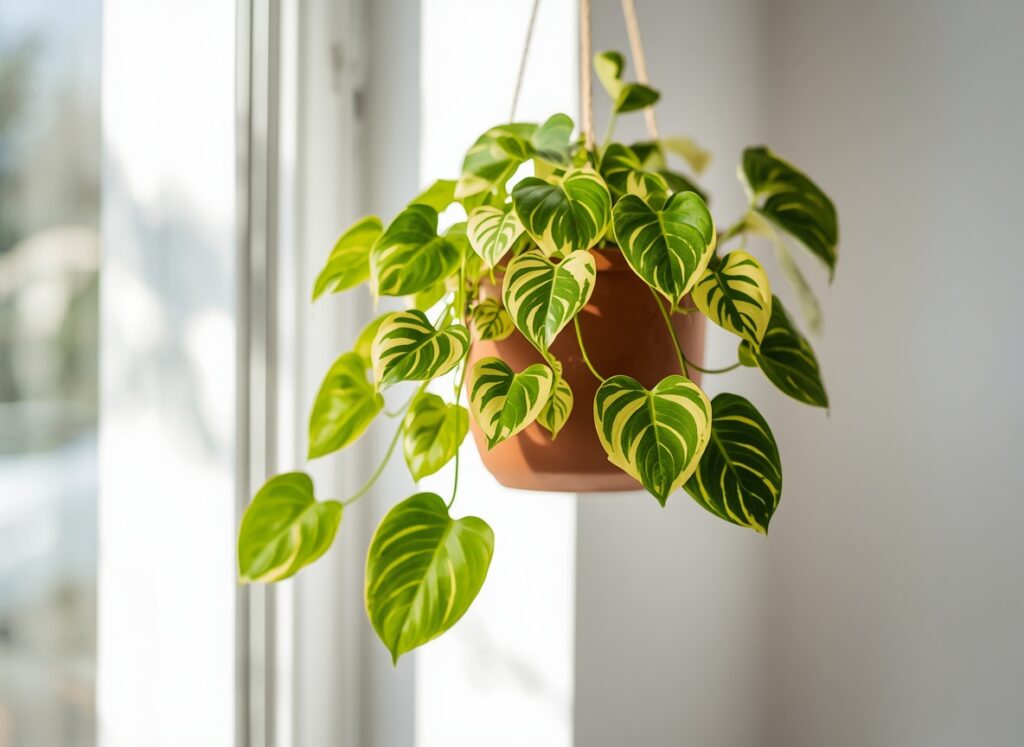
Pothos is one of the most light-adaptable houseplants available. It thrives in bright indirect light but tolerates low light better than almost any other trailing plant. In low light, variegated varieties (Golden Pothos, Marble Queen) lose some of their yellow or white markings and revert toward solid green as the plant produces more chlorophyll to compensate. Solid green varieties maintain their appearance better in low light.
Water
Water when the top one to two inches of soil are dry, roughly every seven to ten days in summer and every two weeks in winter. Pothos tolerates drought far better than overwatering; brown, mushy stems indicate overwatering while yellow leaves that feel papery indicate underwatering.
Soil and Pot
Use standard, well-draining potting mix with added perlite. Any container with drainage holes works. Pothos are not particularly picky about pot material.
Popular Pothos Varieties:
- Golden Pothos (Epipremnum aureum): classic yellow-green variegated; the most widely grown
- Marble Queen: heavily white-variegated; needs more light to maintain white areas
- Neon Pothos: brilliant chartreuse-green; stunning in bright light
- Pearls and Jade: white and green variegation with irregular gray patches; compact
- N’Joy: crisp white and green variegation; distinct geometric pattern
- Manjula: cream, white, and green; wavy leaf edges; increasingly popular
- Cebu Blue: silvery-blue leaves; develops fenestrations with age; increasingly rare
Heartleaf Philodendron Care: The Complete Guide
Light
Heartleaf philodendron prefers medium to bright indirect light but tolerates lower light conditions better than many comparable plants. In very low light, growth slows significantly and leaves become smaller, but the plant rarely declines dramatically. More light produces larger, more vibrant leaves and faster growth.
Water
Water when the top inch of soil is dry, typically every seven to ten days in summer. Heartleaf philodendron is slightly more moisture-loving than pothos and prefers not to dry out as completely between waterings. It also benefits from higher humidity.
Humidity
Heartleaf philodendron appreciates 50 to 70 percent humidity and shows its appreciation through larger, more vibrant leaves. Unlike pothos, which is quite tolerant of dry air, philodendron will develop brown leaf tips in consistently low humidity.
Popular Heartleaf Philodendron Varieties:
- Philodendron hederaceum (standard): glossy, deep green; the original
- Philodendron Brasil: yellow-green central variegation; the most popular variant
- Philodendron Micans: velvety, iridescent bronze-green leaves; highly sought after
- Philodendron Silver Stripe: silver midrib on dark green leaves; elegant
Which Is Better for Beginners?
Both plants are excellent for beginners, but pothos edges ahead for the most inexperienced growers for three reasons: it tolerates lower light levels more gracefully without declining, it handles irregular watering (particularly drought) more forgivingly, and it is slightly less sensitive to low humidity. For beginners who want the most forgiving possible plant, pothos is the choice.
For beginners who want a slightly more refined look, faster growth on a moss pole, or the characteristic bronze new-leaf color, the heartleaf philodendron is equally rewarding and only marginally more demanding.