
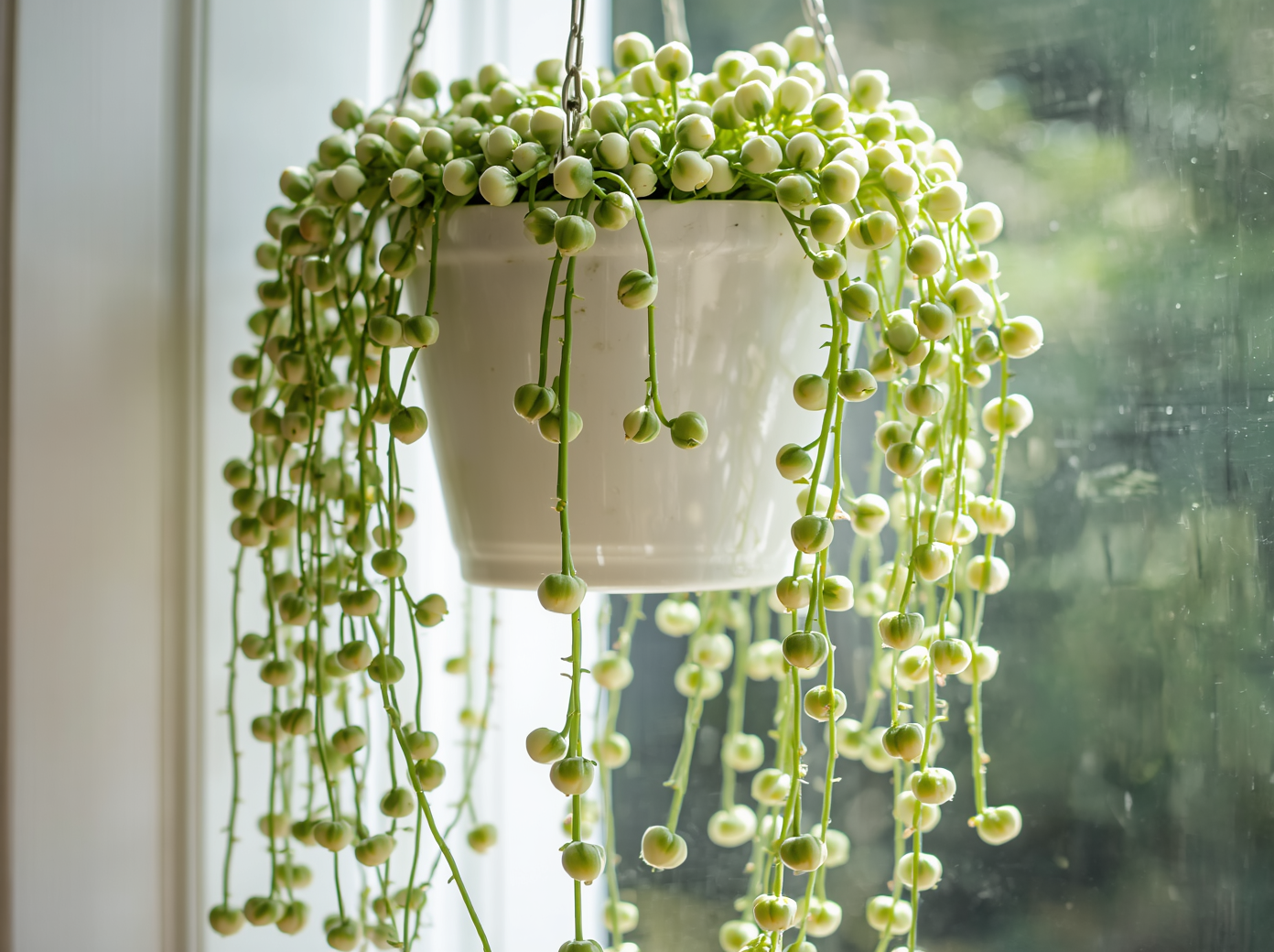
String of pearls (Senecio rowleyanus, now reclassified as Curio rowleyanus) is one of the most visually distinctive plants in the houseplant world. Its long, trailing stems hung with perfectly spherical, pea-like leaves look almost artificial — like a piece of jewelry brought to life. When conditions are right, it produces small, daisy-like flowers with a cinnamon fragrance that surprises many first-time growers.
String of pearls has a reputation for being difficult, and that reputation is partly deserved. It sits at the intersection of two unforgiving requirements: it needs bright light like a cactus but cannot tolerate the drought that most cacti survive easily. Understanding this balance is everything.
Origins: Why It Looks the Way It Does
String of pearls is native to the dry, rocky areas of southwestern Africa, where it grows along the ground and over rocky outcrops in bright, filtered light under sparse scrubby vegetation. The spherical leaf shape is a highly efficient water-storage adaptation: a sphere has the lowest surface-area-to-volume ratio of any shape, minimizing water loss through the leaf surface while maximizing water storage inside.
Each spherical leaf has a small translucent window on one side that allows light to penetrate to the chlorophyll within, enabling photosynthesis while the outer layer remains tough and waxy to minimize moisture loss. This sophisticated design explains why the plant needs bright light (to penetrate those windows) but also why its roots are sensitive to overwatering.
Light Requirements
String of pearls needs bright, indirect light for at least six hours daily, with some direct morning sun being beneficial. A south or east-facing windowsill is ideal. In insufficient light, the pearls space out along the stem rather than sitting close together, producing a straggly, less attractive appearance.
Signs of Insufficient Light:
- Pearls become smaller and more widely spaced along the stems
- Stems elongate and the plant looks sparse rather than dense and lush
- Colors fade from vibrant green to pale yellow-green
Signs of Too Much Direct Sun:
- Pearls shrivel and develop a wrinkled, deflated appearance despite adequate watering
- Leaves may develop pale or silvery patches of sunscald
Watering: The Most Critical Factor
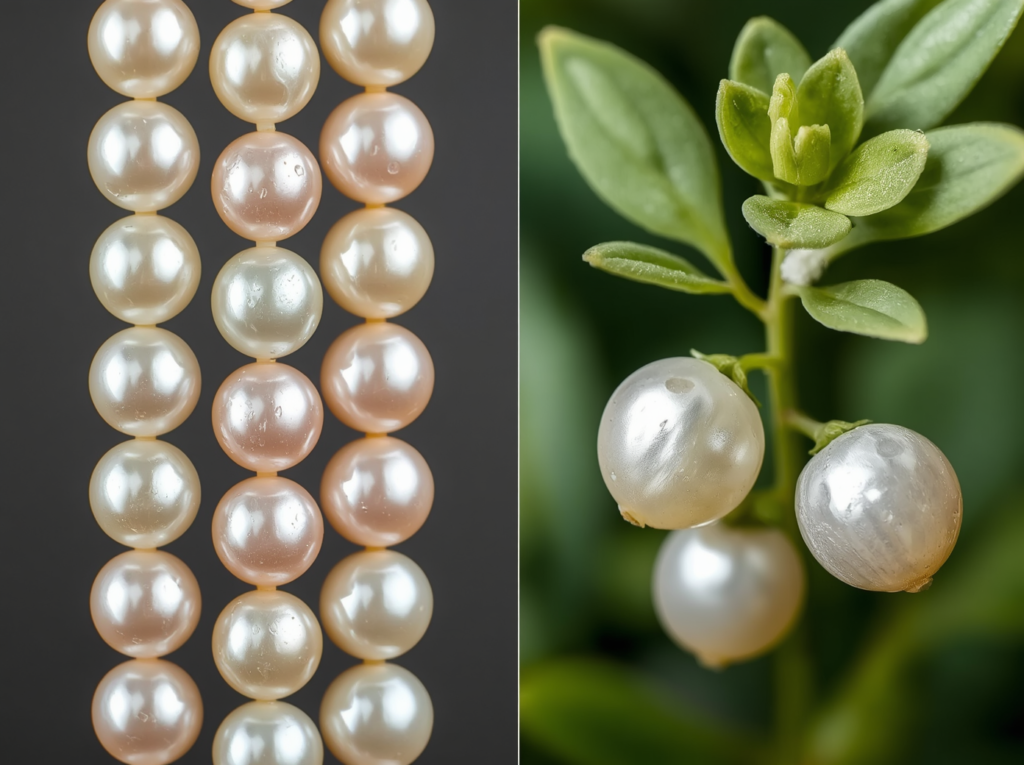
Overwatering is by far the most common cause of string of pearls death. The roots are extremely sensitive to waterlogging, and root rot develops rapidly in consistently moist soil. However, severe underwatering causes the pearls to shrivel and the plant to decline almost as quickly.
The Correct Watering Method:
- Water thoroughly when the top half of the soil is completely dry, typically every ten to fourteen days in summer
- Reduce to every three to four weeks in winter during the plant’s semi-dormant period
- Always water until it flows from the drainage hole, then allow to drain completely
- Never let the plant sit in water in the saucer
The Pearl Squeeze Test:
The most reliable way to assess whether your string of pearls needs water is to gently squeeze a pearl between your fingers. Firm, slightly resistant pearls are perfectly hydrated. Soft, easily squeezed pearls indicate overwatering. Slightly wrinkled, deflated pearls indicate it is time to water.
Soil and Pot Requirements
Soil
String of pearls needs extremely well-draining soil. A dedicated cactus and succulent mix with additional coarse sand or perlite at a 50:50 ratio is ideal. Standard potting mix alone retains far too much moisture.
Pot Choice
Terracotta pots are strongly recommended because their porous walls wick moisture away from the soil, significantly reducing root rot risk. Hanging planters or elevated positions allow the long stems to cascade freely, which is both aesthetically ideal and practically beneficial since it prevents the stems from sitting in any potential moisture.
Propagation: The Easiest Method
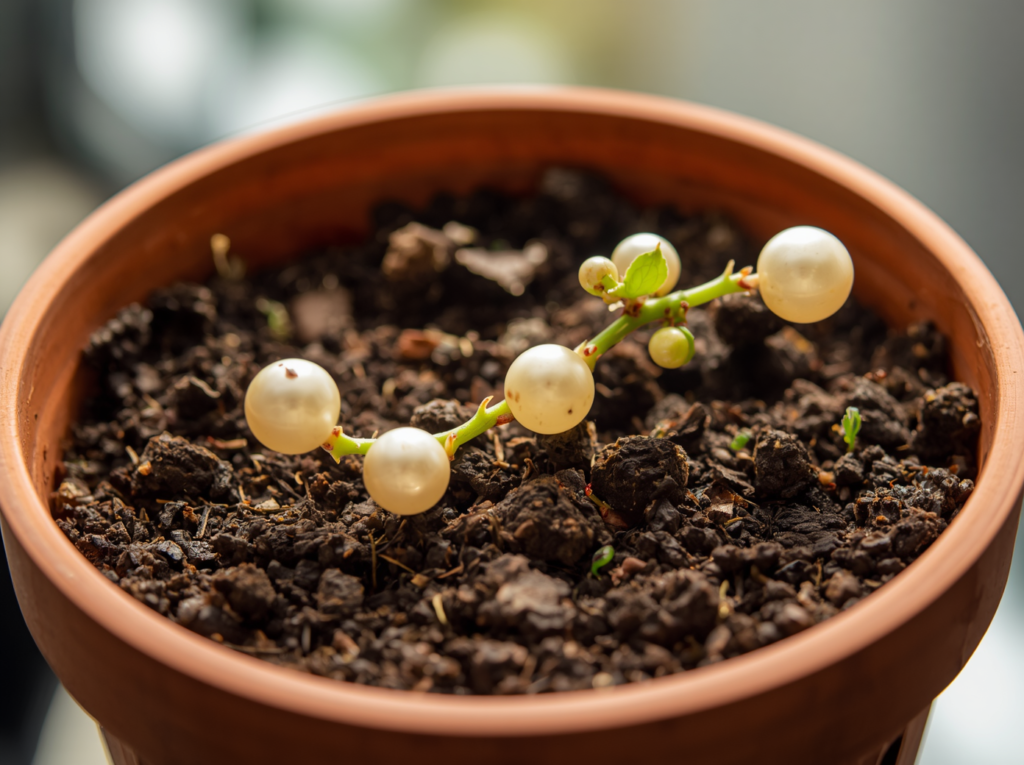
Stem Cutting Method (Most Reliable):
- Cut a healthy stem of four to six inches with clean, sterilized scissors
- Remove the pearls from the bottom inch of the stem to expose bare stem
- Allow the cut end to callus (dry) for one to two hours
- Lay the cutting on top of moist succulent soil or press the bare stem end lightly into the soil
- Do not water for five to seven days to allow callusing and root initiation
- Roots form in two to three weeks; new pearl growth confirms successful rooting
Layering Method:
Pin long stems onto the surface of a pot of succulent soil using hairpins or bent wire. The stem nodes in contact with moist soil will develop roots within three to four weeks. Once rooted, cut the stems from the mother plant to create independent new plants.
Common String of Pearls Problems
Shriveling Pearls (Not Watering-Related)
If pearls shrivel despite regular watering and the soil feels moist, root rot is the likely cause. Healthy roots cannot be present if the soil has been consistently wet. Remove the plant from its pot, inspect roots, trim any brown or mushy roots, allow to dry for two days, and repot in fresh succulent mix.
Pearls Dropping Off
Loose, falling pearls usually indicate overwatering or physical damage. They do not need to be discarded; individual pearls can be laid on top of moist succulent soil and may root and develop into new plants over several weeks.
Flat or Deflated Pearls
If pearls become flat or develop a flat side rather than remaining perfectly spherical, the plant has experienced either severe underwatering or is receiving too much direct sun, causing excessive water loss through the leaf surface. Correct the light and watering and new growth will be normal.
Related Trailing Succulents Worth Knowing
- String of Hearts (Ceropegia woodii): delicate heart-shaped leaves on purple trailing stems; easier than string of pearls
- String of Bananas (Senecio radicans): banana-shaped leaves; easier and faster-growing than string of pearls
- String of Dolphins (Senecio peregrinus): leaves shaped like tiny leaping dolphins; rare and highly sought-after
- String of Turtles (Peperomia prostrata): tiny turtle-shell patterned leaves; requires more moisture than string succulents
- String of Nickels (Dischidia nummularia): round, coin-like leaves; epiphytic; requires humidity and bark-based mix