
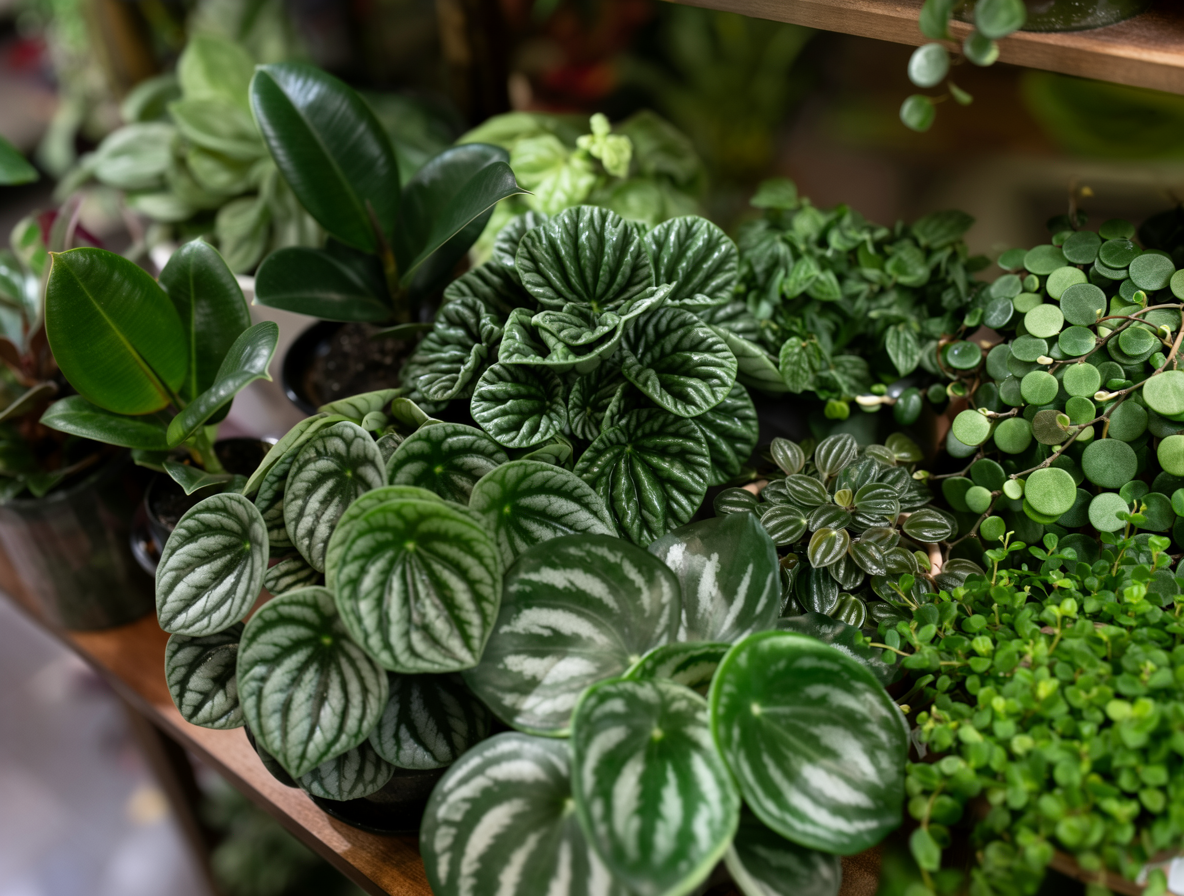
Peperomia is one of the largest genera of houseplants, with over 1,000 species and cultivars offering an extraordinary diversity of leaf shape, texture, color, and growth habit. From the iconic Watermelon Peperomia with its striped foliage to the deeply ruffled texture of Peperomia caperata, the trailing form of Peperomia scandens, and the tiny succulence of Peperomia graveolens, no two peperomias look alike.
Despite their diversity, peperomias share a set of care requirements that make them among the most forgiving and rewarding of all houseplants. They tolerate low light, irregular watering, and lower humidity better than most tropical plants. They stay compact, rarely need repotting, and propagate easily. They are, in short, almost perfect houseplants.
Peperomia Care Fundamentals
Light
Most peperomias prefer bright to medium indirect light and will tolerate lower light conditions reasonably well. Variegated varieties and those with lighter-colored foliage need slightly more light than solid dark green varieties. Direct sun bleaches leaves and causes damage.
Water
This is where most peperomia growers go wrong. Peperomias store water in their thick leaves and stems, making them semi-succulent and much more drought-tolerant than their lush appearance suggests. Water when the top half of the soil is completely dry, typically every ten to fourteen days in summer and every three weeks in winter. Overwatering is the number one killer.
Soil
A well-draining mix is essential. Use standard potting mix with 30 to 40 percent added perlite, or a dedicated succulent mix. Peperomias dislike waterlogged soil but do not need the extreme drainage of true cacti.
Humidity
Most peperomias tolerate average indoor humidity of 40 to 50 percent perfectly well. This is one of their key advantages over many tropical houseplants.
Pot Size
Peperomias actively prefer being somewhat root-bound and rarely need repotting more than once every two to three years. Always move up only one pot size.
The 25 Best Peperomia Varieties
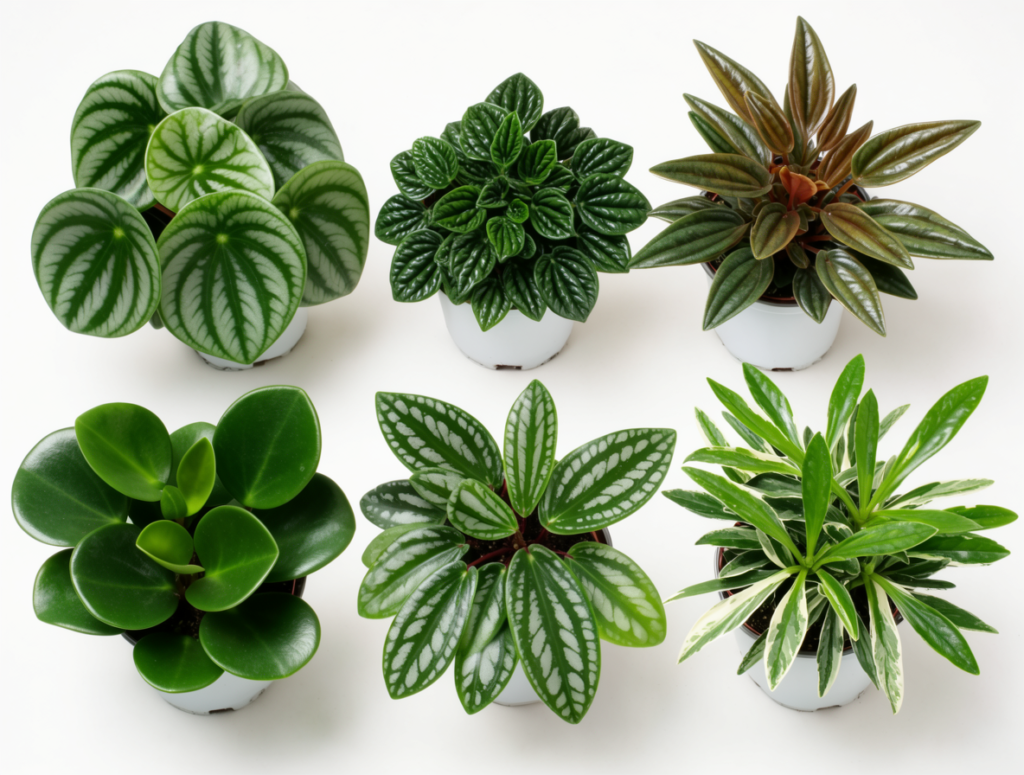
Classic and Most Popular Varieties
1. Watermelon Peperomia (Peperomia argyreia)
The most beloved and widely grown peperomia, with rounded leaves featuring silvery stripes radiating from the center like a watermelon rind on dark green. It grows in a compact, bushy mound and propagates easily from leaf cuttings. One of the most beginner-friendly peperomias.
2. Ripple Peperomia (Peperomia caperata)
Deeply corrugated, heart-shaped leaves in dark green, burgundy, or silver-grey create extraordinary texture. It produces upright, rat-tail-like flower spikes that add additional visual interest. One of the most textured of all houseplants.
3. Baby Rubber Plant (Peperomia obtusifolia)
Large, glossy, oval, deep green leaves that resemble a miniature rubber plant. Extremely easy to grow, tolerates lower light well, and produces an attractive, bushy form. Variegated forms with cream edges are also widely available.
4. Coin Leaf Peperomia (Peperomia polybotrya)
Also known as Raindrop Peperomia, it produces large, glossy, teardrop-shaped leaves. Similar in appearance to Pilea peperomioides (Chinese money plant) but more compact and even easier to care for.
5. String of Turtles (Peperomia prostrata)
A trailing peperomia with tiny, round leaves patterned like turtle shells in green and silver. Stunning in hanging baskets and terrariums. Requires slightly more moisture than most peperomias due to its smaller leaf size.
Textured and Unusual Varieties
6. Peperomia graveolens (Ruby Glow)
A succulent peperomia with V-shaped, channeled leaves that are dark red underneath and translucent window-green on top. One of the most uniquely shaped and colored peperomias, resembling a miniature aloe more than a typical peperomia.
7. Peperomia metallica
Narrow, elongated leaves with a metallic sheen in dark red and copper tones with a central silver stripe. One of the most striking foliage colors in the genus.
8. Peperomia albovittata (Piccolo Banda)
Broad leaves with a beautiful pewter-silver color and slightly quilted texture. One of the most elegant and sophisticated-looking peperomias.
9. Peperomia rosso
Deep forest green, highly corrugated leaves with brilliant red-purple undersides that glow when backlit. Excellent in hanging positions where the undersides of the leaves are visible.
10. Peperomia incana
Covered in dense white hairs that give the round leaves a fuzzy, silver-grey appearance. Highly textural and unusual. More drought-tolerant than smooth-leaved varieties.
Trailing and Compact Varieties
11. Peperomia scandens (Cupid Peperomia)
A trailing variety with heart-shaped, pale green or variegated cream-edged leaves. Fast-growing and excellent in hanging baskets or cascading from shelves.
12. Peperomia rotundifolia
Trailing stems with tiny, round, bright green leaves. Creates a delicate, moss-like curtain when allowed to trail from a hanging position. Perfect for terrariums.
13. Peperomia quadrangularis (Beetle Peperomia)
Small, paddle-shaped dark green leaves with yellow veining. Low-growing and trailing. Produces an intricate carpet-like display in terrariums.
14. Peperomia nivalis
A tiny succulent peperomia forming dense clusters of narrow, boat-shaped leaves. Grows in rosette-like clusters that slowly multiply. Excellent for dish gardens and small containers.
15. Peperomia emarginella
Minute trailing stems with tiny round leaves. Creates an extremely delicate curtain effect in terrariums and hanging positions. One of the smallest peperomia species available.
Variegated and Colorful Varieties
16. Peperomia obtusifolia Variegata
The variegated form of baby rubber plant with creamy-white and green marbled leaves. One of the most widely available and easiest variegated peperomias.
17. Peperomia clusiifolia Rainbow
Broad leaves with a dramatic tri-color variegation of green, cream, and pink-red edges. The pink tones intensify with more bright light exposure. Compact and upright.
18. Peperomia orba Pixie Lime
Bright chartreuse-lime colored small rounded leaves on a compact trailing plant. The intense color provides a vivid accent among darker-leaved plants.
19. Peperomia caperata Silver Ripple
A silver-grey form of the classic ripple peperomia. The metallic silver coloring combined with the deeply corrugated texture creates an almost alien-looking plant.
20. Peperomia puteolata (Stilt Peperomia)
Long, lance-shaped leaves with bold cream and green stripes on reddish stems. Upright and compact with a distinctly architectural quality.
Rare and Collector Varieties
21. Peperomia dolabriformis (Prayer Pepper)
Highly succulent, folded leaves that resemble tiny green pouches or closed books. A truly bizarre and fascinating form that is genuinely unlike any other plant.
22. Peperomia columella
A columnar succulent peperomia with stacked, scale-like leaves arranged around upright stems. Resembles a tiny columnar cactus and is one of the most unusual peperomia forms.
23. Peperomia ferreyrae (Pincushion Peperomia)
Long, narrow, succulent leaves with a transparent window along the top edge. Somewhat resembles a Haworthia or Gasteria in form. Very drought-tolerant.
24. Peperomia verticillata (Red Log)
Dense whorls of small, dark green leaves with brilliant red undersides on upright stems. The red contrast is stunning, particularly in bright light which intensifies the color.
25. Peperomia elongata
Soft, velvety, elongated leaves on trailing stems. The texture is unusually soft for a peperomia, making it tactilely distinctive as well as visually interesting.
Propagating Peperomias
Leaf Cuttings (Most Species)
- Cut a healthy leaf with its petiole (leaf stalk) using clean scissors
- Allow to callus for one to two hours
- Insert the petiole into moist propagation mix at a 45-degree angle
- Cover with a clear plastic bag to maintain humidity
- New plantlets emerge at the base of the petiole in three to six weeks
Stem Cuttings (Trailing Varieties)
- Cut a stem with two to three nodes
- Remove the lower leaves to expose the node
- Root in water or moist perlite; roots form in two to four weeks